Abstract
Sometimes, MLLMs generate incorrect outputs but with correct frame-level semantics. We refer to this type of hallucination as Semantic Aggregation Hallucination (SAH), which arises during the process of aggregating frame-level semantics into event-level semantic groups. We introduce ELV-Halluc, the first benchmark dedicated to long-video hallucination, enabling a systematic investigation of SAH. Our experiments confirm the existence of SAH and show that it increases with semantic complexity. Additionally, we find that models are more prone to SAH on rapidly changing semantics. Moreover, we discuss potential approaches to mitigate SAH. We demonstrate that positional encoding strategy contributes to alleviating SAH, and further adopt DPO strategy to enhance the model’s ability to distinguish semantics within and across events. To support this, we curate a dataset of 8K adversarial data pairs and achieve improvements on both ELV-Halluc and Video-MME.
-
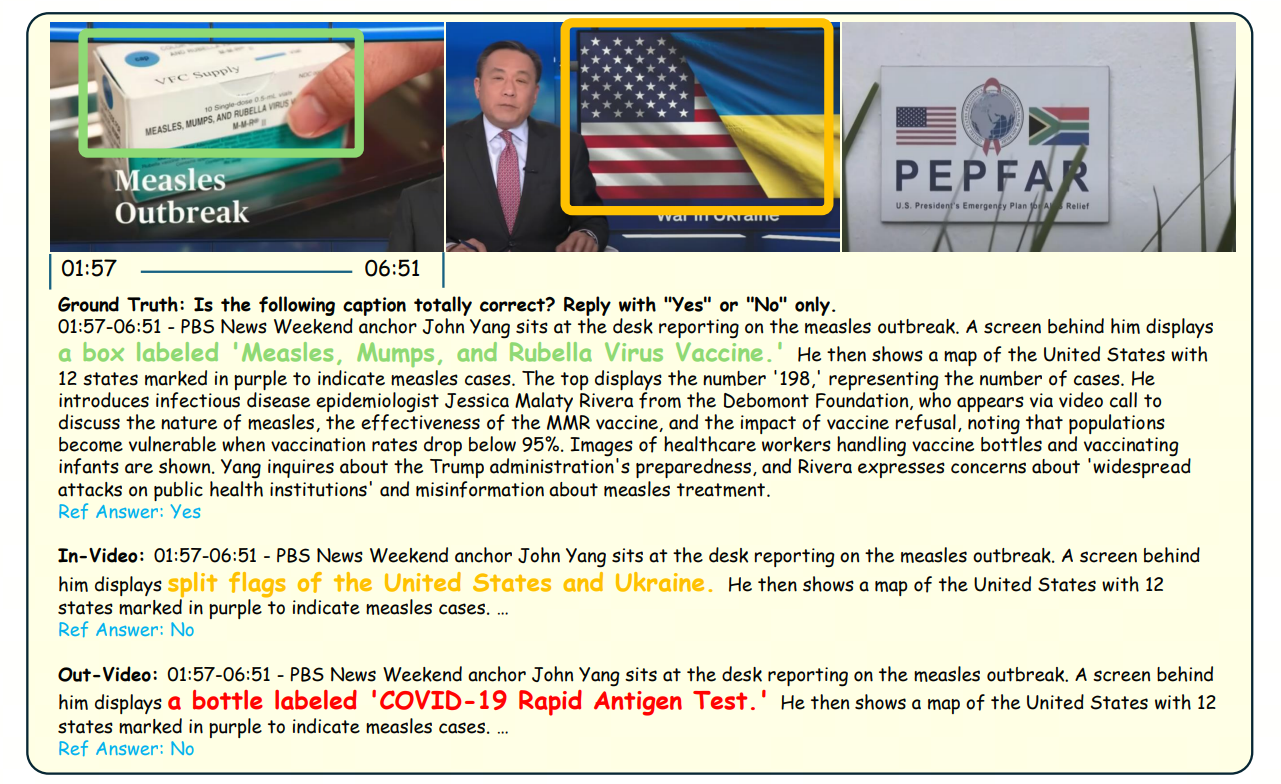
Showcase for visual details QA pairs.
-
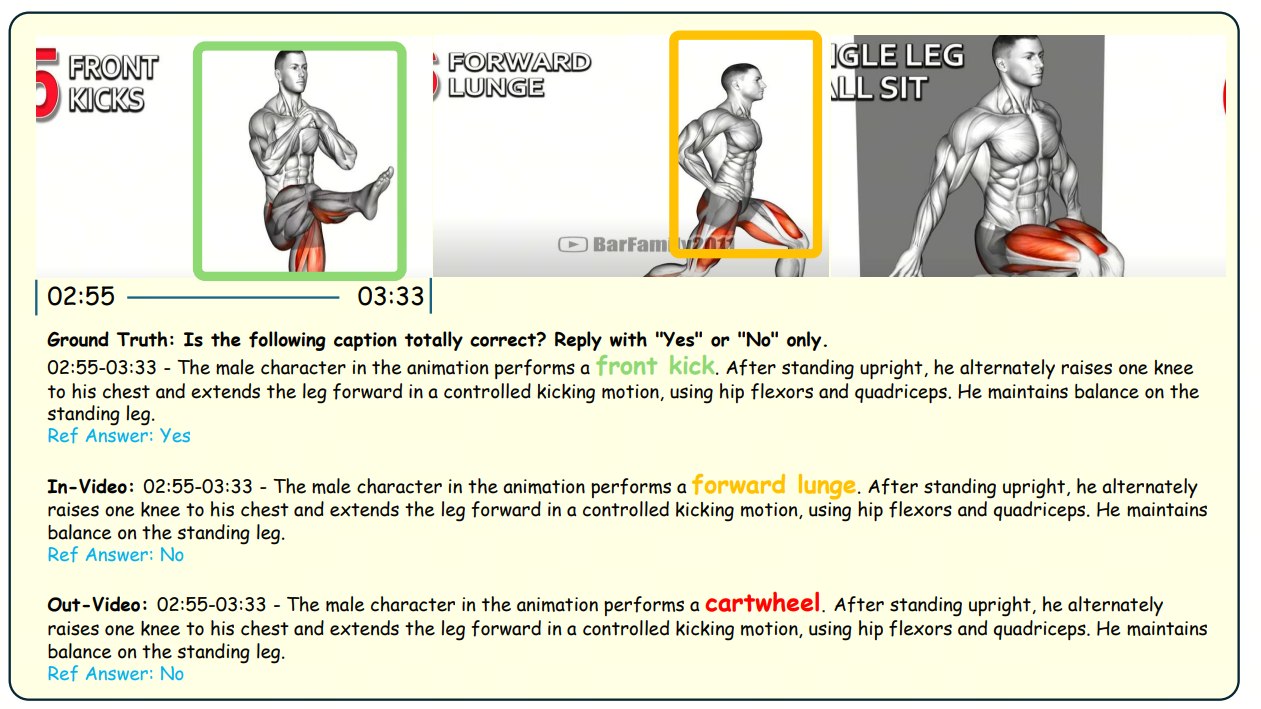
Showcase for action QA pairs.
-
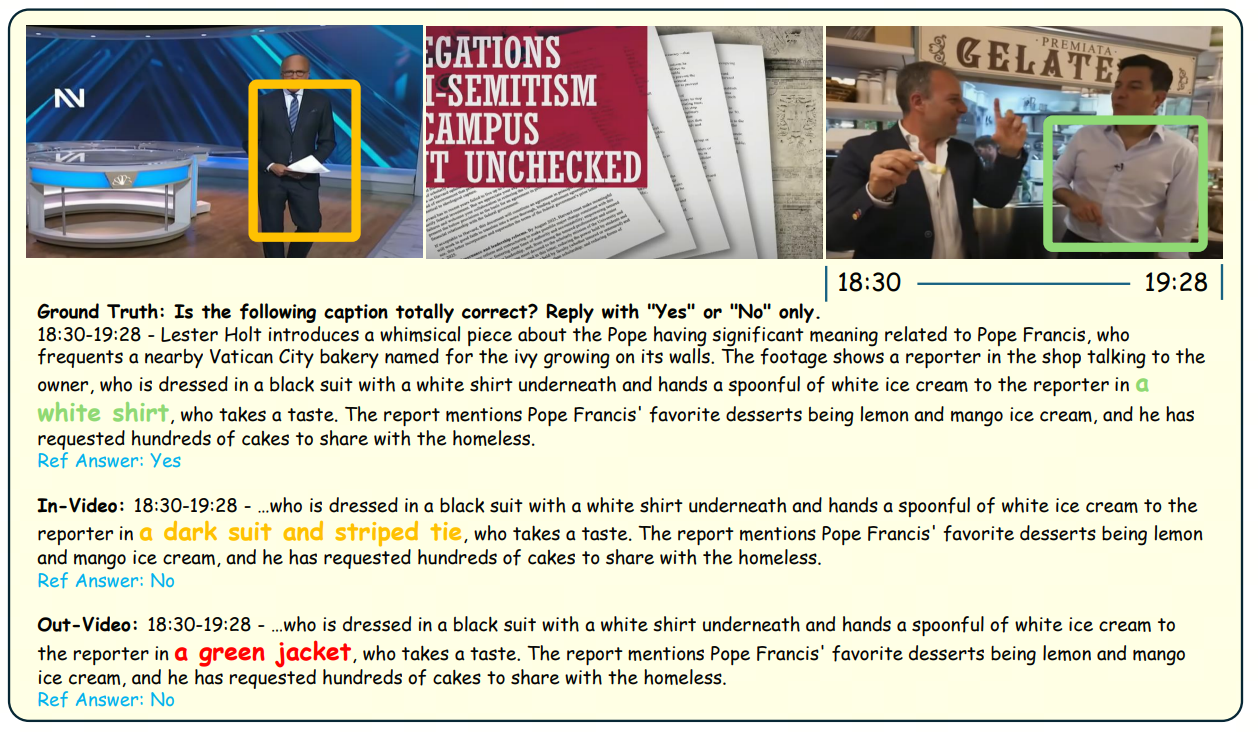
Showcase for object QA pairs.
-
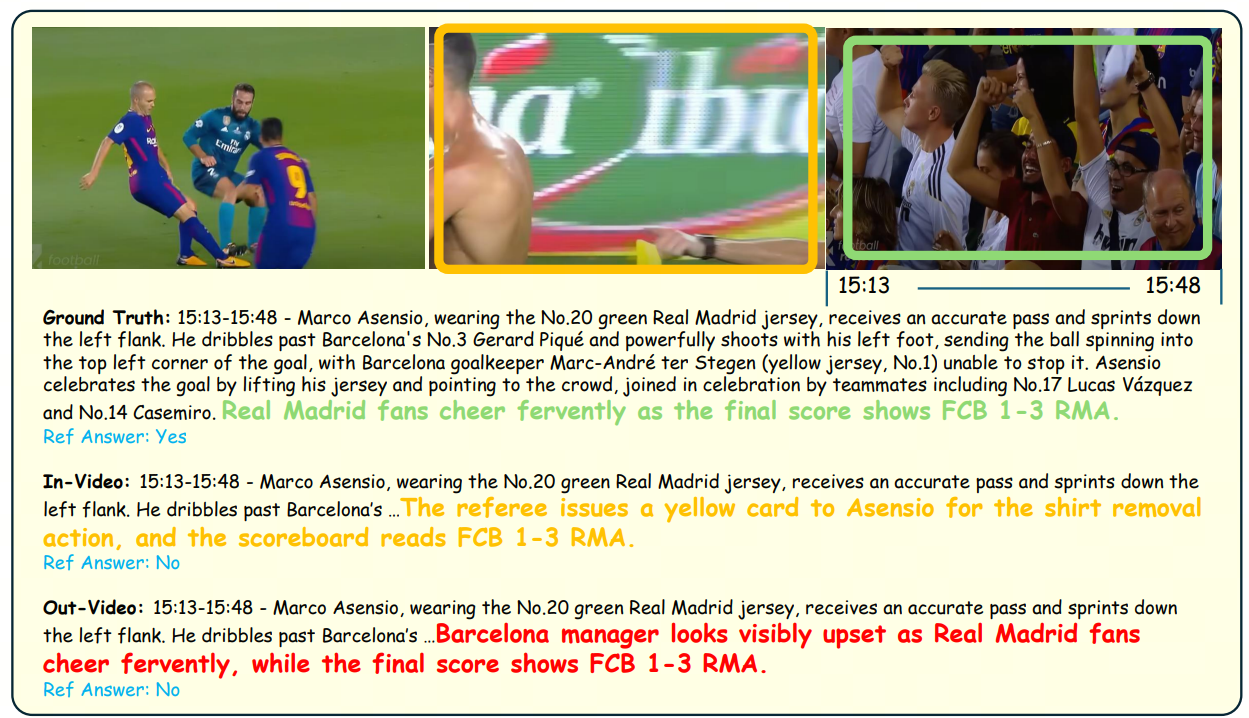
Showcase for declarative content QA pairs.
BibTeX
@misc{lu2025elvhallucbenchmarkingsemanticaggregation,
      title={ELV-Halluc: Benchmarking Semantic Aggregation Hallucinations in Long Video Understanding},
      author={Hao Lu and Jiahao Wang and Yaolun Zhang and Ruohui Wang and Xuanyu Zheng and Yepeng Tang and Dahua Lin and Lewei Lu},
      year={2025},
      eprint={2508.21496},
      archivePrefix={arXiv},
      primaryClass={cs.CV},
      url={https://arxiv.org/abs/2508.21496},
}